In precision manufacturing, the process of heat treatment plays a pivotal role in transforming the physical and mechanical properties of components. From enhancing hardness to improving wear resistance, the heat treatment processes help components meet demanding requirements in industries like automotive, medical, defence, aerospace, tooling etc.
Through this entire process, there is one thing that is always overlooked. The one step that bookends the heat treatment process- cleaning. Specifically, the need to clean components before they enter the furnace and once more after they come out.
At NGCT Cleansys, we provide you with the vacuum-assisted solvent-based part cleaning systems that deliver the level of performance, consistency, and cleanliness that is demanded by the heat-treatment process. Here are a few reasons why solvent cleaning for your parts is an important and trusted solution.
Pre-heat treatment cleaning- setting the stage for perfection
Before heat treatment, most components are coated with coolants, lubricants, cutting fluids, greases, or protective coatings from machining or handling. If these contaminants are not removed,
- They can react under high temperatures, causing scale or residue build-up.
- The part’s surface hardness or case depth may be compromised.
- Oxides or carbides can form, leading to poor metallurgical transformation.
- It can negatively affect uniformity, especially in vacuum or induction heat treatments.
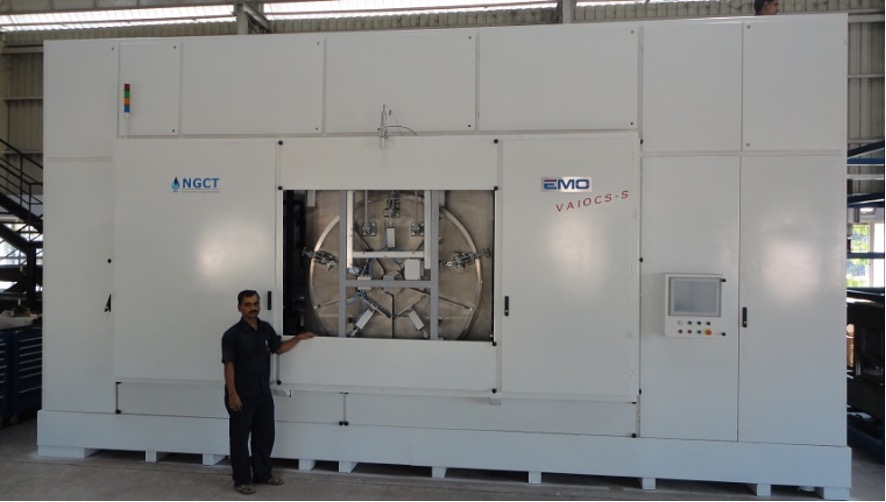
This is where solvent cleaning systems excel. NGCT Cleansys’ solvent-based solutions, like the VAIOCS and SOLVACS systems, use modified alcohol or hydrocarbon solvents under vacuum to thoroughly remove organic residues without watermarks, or surface disruptions.
This provides us with machine parts that are chemically and visually clean and ensures that the heat treatment achieves the desired metallurgical results with precision and repeatability.

Post-heat treatment cleaning- removing the unseen threats
After heat treatment, components may carry:
- Oxide scale and surface discolouration
- Residual quenching oils in SQF process lines
- Solidified films or vapours that form during the high-temperature cycle
- Fine metal particles from handling or cooling processes.
If left untreated, these components can:
- Interfere with coating, welding, or further machining and gauging processes.
- Cause surface corrosion or pitting.
- Lead to non-conformities in inspections or certifications.
- Shorten part life or compromise performance in end-use.
Using a vacuum-assisted solvent machine after heat treatment ensures these residues are completely removed, especially in hard-to-reach cavities, blind holes, or threaded areas in a manner that is extremely efficient and cost-effective. Unliked water-based systems, solvent cleaning ensures fast, drying, low energy consumption, and zero eater spotting, making it ideal for high-value or tight-tolerance parts. Also, the separation of waste oil and purification of solvent takes place continuously.
Why solvent cleaning is the industry standard
While aqueous cleaning has its place, solvent systems remain the preferred solution for the heat treatment process because it provides:
- Deep penetration as solvent flows into microscopic crevices and threads due to low surface tension properties.
- High degreasing power that is perfect for removing heavy hydrocarbons, oils, and waxes.
- Very less drying time as solvent evaporation under vacuum helps the parts dry instantly.
- Compact footprint as the machines are more space efficient and easier to automate.
- Low environmental impact because they operate in a closed-loop vacuum, with minimal emissions and solvent recovery.
- No hassles of treating generated waste water like in Aqueous machines.
Pre + post cleaning: a complete lifecycle approach
For most industries, the real benefit lies in combining both pre- and post-treatment cleaning into their production line. Pre-treatment removes machining oils and enables uniform heat exposure. Post-treatment ensures that the part meets cleanliness standards for inspection, assembly, or coating or any further processes. Combining both the cleaning processes help improve the longevity of parts and prevent surface recontamination.
From gear shafts and fasteners to surgical instruments and aerospace turbine blades, solvent cleaning delivers repeatable, validated results every time.
How can NGCT Cleansys benefit your heat treatment process?
Heat treatment is about more than just temperature; it is about control and contamination management. And this starts and ends with properly configured cleaning system. With customisable models, modular configurations and safety certifications NGCT’s vacuum-assisted solvent part cleaning systems are built to withstand hard production environments, and we can help you design a solution that balances efficiency, performance, and compliance.
Want to upgrade your cleaning process?
Explore our Solvent vs Aqueous Cleaning Comparison, or contact us today for a tailored consultation with our engineering team.