How vacuum-assisted solvent distillation is transforming industrial solvent management.

The Overlooked Opportunity in Solvent Management
In the race toward smarter, more sustainable manufacturing, businesses are optimising supply chains, adopting automation, and investing in cleaner technologies. Yet one critical area often remains under-optimised: industrial solvent management.
Solvents are essential across industries, from precision cleaning/degreasing to parts manufacturing. However, solvents once contaminated, they are typically treated as waste and disposed of, creating ongoing costs and environmental impact.
But this raises an important question:
What if solvent waste isn’t waste at all, but a recoverable resource?
The Problem with Traditional Solvent Disposal
In many conventional systems, contaminated solvent streams can contain up to 50% reusable solvent. Despite this, the default approach remains disposal. This linear model of use, contaminate, discard, creates several challenges:
- Rising solvent procurement costs.
- High hazardous waste disposal expenses.
- Increased environmental footprint.
- Inefficient use of valuable resources.
For industries operating at scale, this is not just a technical inefficiency, it is a missed strategic opportunity.
The Shift to Circular Solvent Management
As manufacturing evolves, so does the approach to resource utilisation. Leading organisations are moving toward a circular model, that follows a Use → Recover → Reuse, process.
This approach redefines solvent management as a closed-loop system, where materials are continuously recovered and reintegrated into operations.
At the centre of this shift is a technology that is rapidly gaining traction:
What is Vacuum-Assisted Solvent Distillation?
Vacuum-assisted solvent distillation is an advanced process that separates solvents from contaminants such as oils and residues, under controlled vacuum conditions.
These machines operate under vacuum, consequently lowering the boiling point of solvents, enabling:
- Safer processing at lower temperatures.
- Efficient separation of solvents having flash points.
- Reduced risk in handling volatile compounds.
- Higher extraction rate
This process helps with the recovery of high-quality solvent that can be reused within the production cycle.
Turning Waste into Value with Advanced Recovery Systems
Modern systems like the NGCT Vacuum Assisted Solvent Distillation System (Vac-D Series) are designed to integrate this process seamlessly into industrial environments.
These systems enable:
- Up to 90% solvent recovery, significantly reducing raw material costs.
- Continuous, automated operation, minimising manual intervention.
- Consistent solvent quality, ensuring reliable performance.
- Enhanced safety and regulatory compliance, especially in controlled environments.
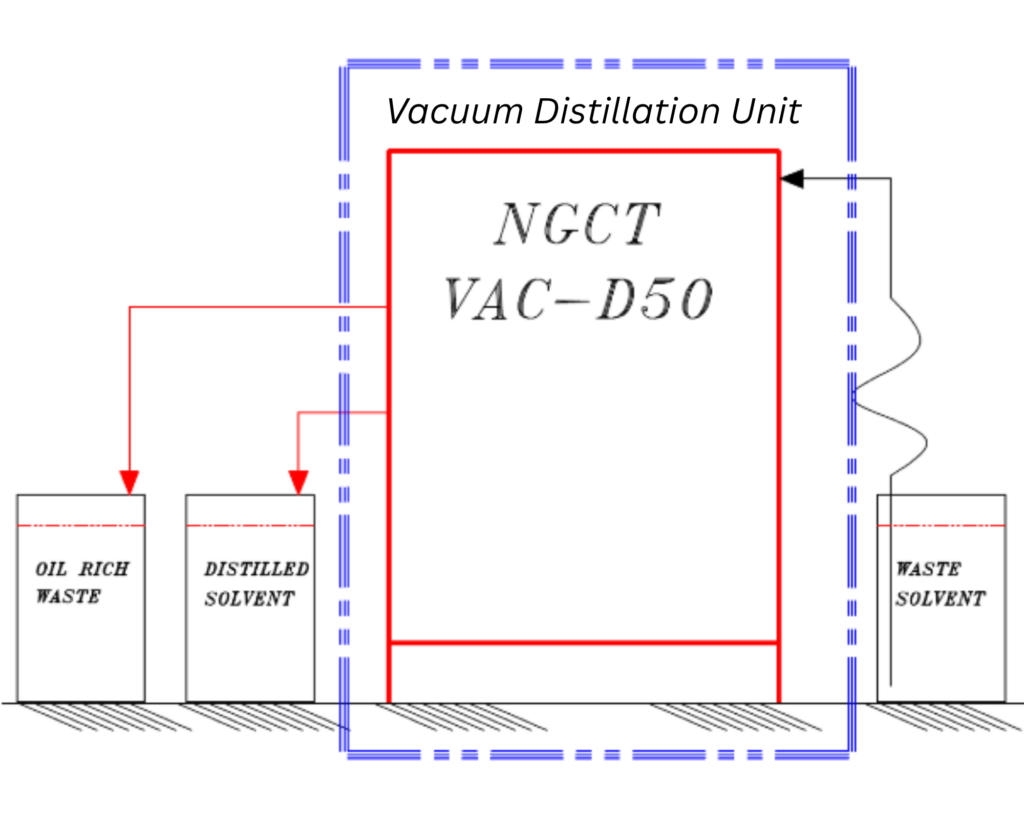
Rather than treating solvent recovery as an add-on, these systems embed it directly into the operational workflow, transforming how businesses approach solvent use.
Beyond Cost Savings: Why Solvent Recovery is a Strategic Imperative
While cost reduction is a clear benefit, the impact of solvent recovery extends far beyond immediate savings.
1. Sustainable Manufacturing
Recovering solvents reduces hazardous waste and supports environmental goals, aligning with ESG and sustainability initiatives.
2. Operational Efficiency
Automated recovery systems streamline processes, reduce downtime, and improve workflow continuity.
3. Risk Reduction & Compliance
Controlled vacuum systems enhance workplace safety and help meet increasingly stringent environmental regulations while recycling solvents with flash points.
4. Resource Optimisation
Maximising the lifecycle of solvents ensures businesses extract full value from their inputs.
What Comes Next: Building a Smarter Solvent Strategy
As industries continue to prioritise sustainability and efficiency, solvent recovery will play an increasingly important role in operational strategy.
Future-focused organisations will look beyond individual technologies and consider:
- How solvent recovery integrates into their overall process design.
- Opportunities to automate and scale recovery systems.
- Ways to measure and optimise solvent lifecycle performance.
This is just the beginning of a broader transformation in industrial resource management.
Conclusion: From Disposal to Opportunity
The transition from waste disposal to solvent recovery is not just an operational improvement, it is a strategic evolution.
By adopting advanced solutions like vacuum-assisted distillation, businesses can:
- Reduce costs
- Improve sustainability
- Enhance safety
- Unlock long-term value
In a world where efficiency and responsibility go hand in hand, the real opportunity lies in rethinking what we define as “waste.” Because in modern manufacturing, waste is no longer the end of the process, it is where new value begins.