
When production volumes climb into thousands of parts a day, cleaning can quietly become the bottleneck. Manual dip tanks and standalone wash stations struggle to keep pace, and inconsistent cleaning quality starts showing up downstream as rework, rejections, or field failures. Tunnel washers, also known as continuous belt washers, exist to solve exactly this problem: they turn parts cleaning into a continuous, automated process built for volume, without giving up on consistency.
What a tunnel washer actually does
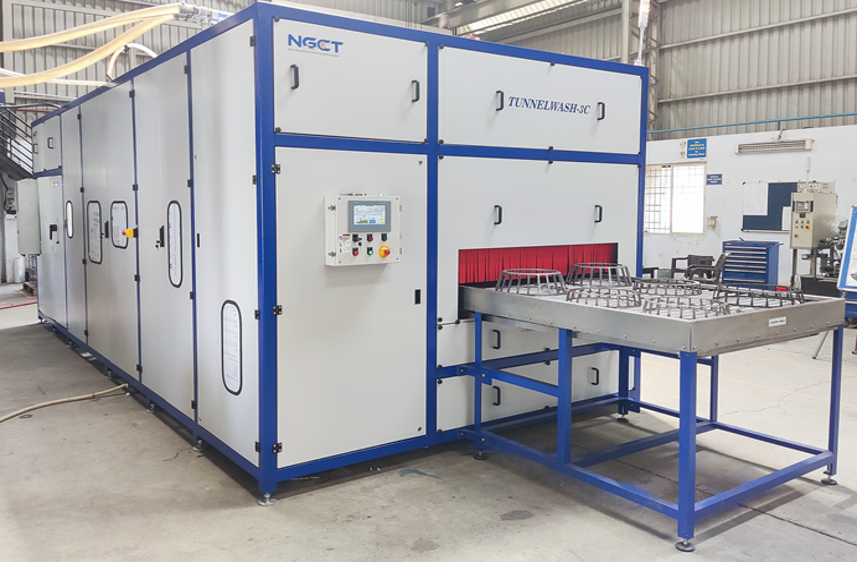
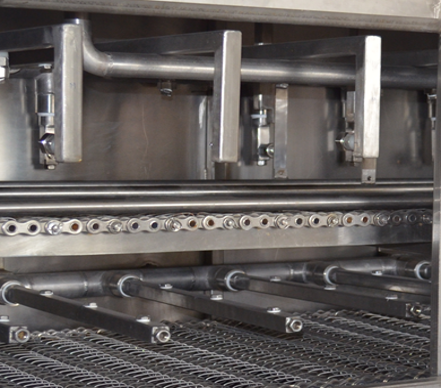
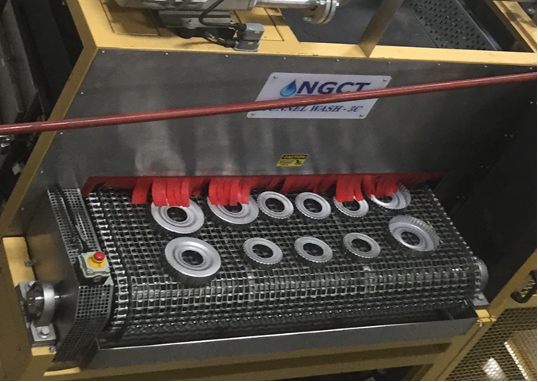
A tunnel washer moves parts on a steady, continuous conveyor mesh belt or pallet through a sealed tunnel chamber. As the belt travels, parts pass through a series of consecutive processing zones, typically spray-washing with chemical cleaning agents, boat-shaped dip ultrasonic cleaning, spray rinsing, and hot air blow-drying, all in a single uninterrupted pass. Instead of batching parts through separate tanks and handling them manually between steps, the entire cleaning cycle happens in one line.
This matters most for flat, relatively simple-geometry parts running at high volumes: bearing cage components, Ev battery cooling plates, simplex gears, external splined shafts, and similar production parts where throughput and repeatability matter as much as the cleaning result itself.
Multiple zones, one continuous pass
What makes a tunnel washer effective is not any single stage, it is the sequence. Each zone is doing a specific job:
- Spray-wash with chemical cleaning breaks down oils, coolant residue, and particulate on the part surface.
- Boat-shaped dip ultrasonic cleaning reaches into geometry that spray alone cannot fully clean, using cavitation to dislodge finer contaminants.
- Spray rinsing clears cleaning chemistry and loosened residue before the part moves on.
- Hot air blow drying ensures parts exit the line ready for the next process step, not sitting wet on a rack.
Because every part follows the same path through the same zones at the same speed, the result is uniform cleanliness, part after part, without depending on how carefully an operator handled the last dip tank.
Built to scale, from 2-chamber to multiple-chamber lines
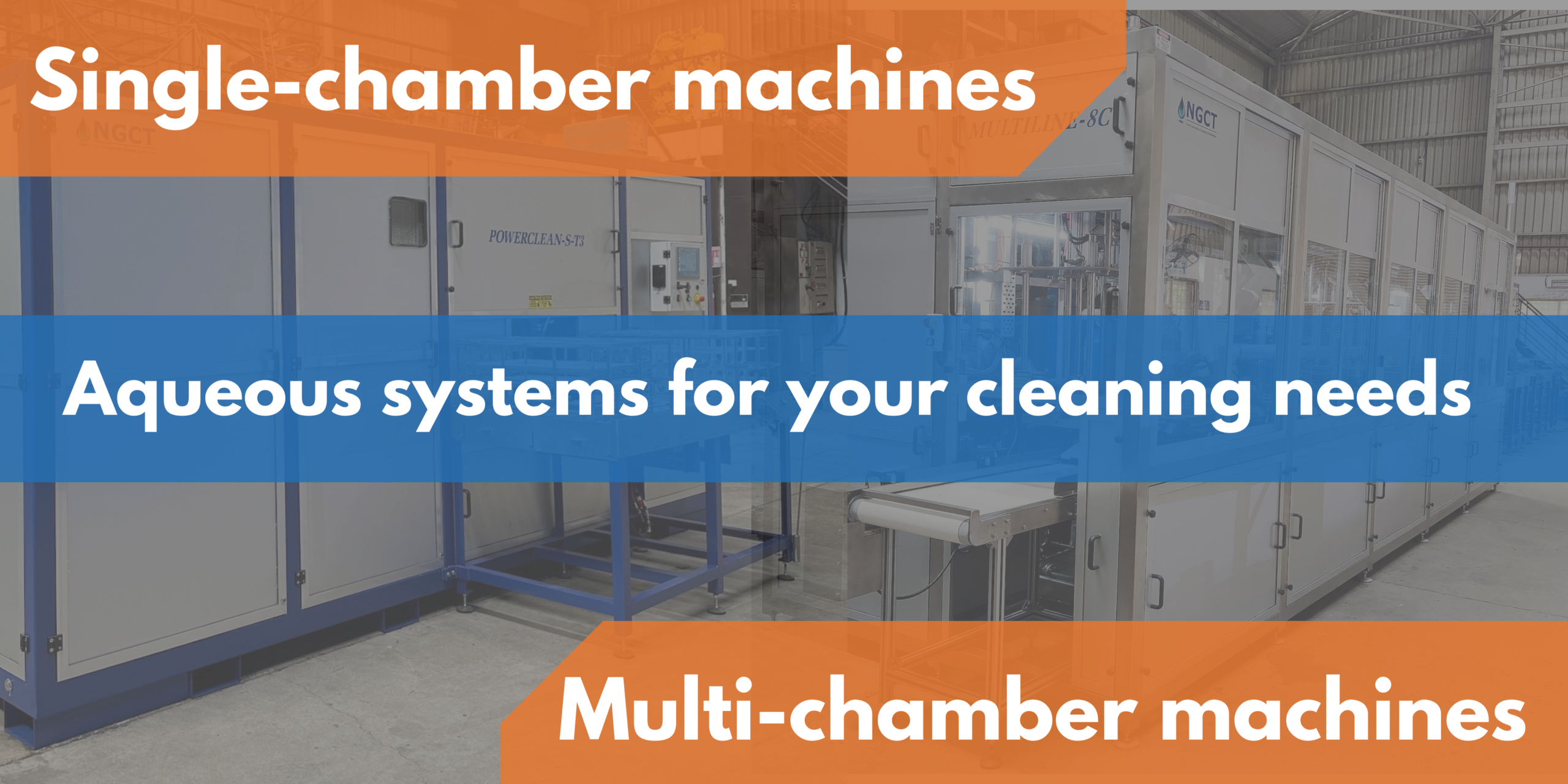
Not every production line needs the same footprint. NGCT’s TunnelWash systems sale from compact 2-chamber configurations up to multiple-chamber lines, depending on the contamination level, part geometry, and throughput a customer needs.
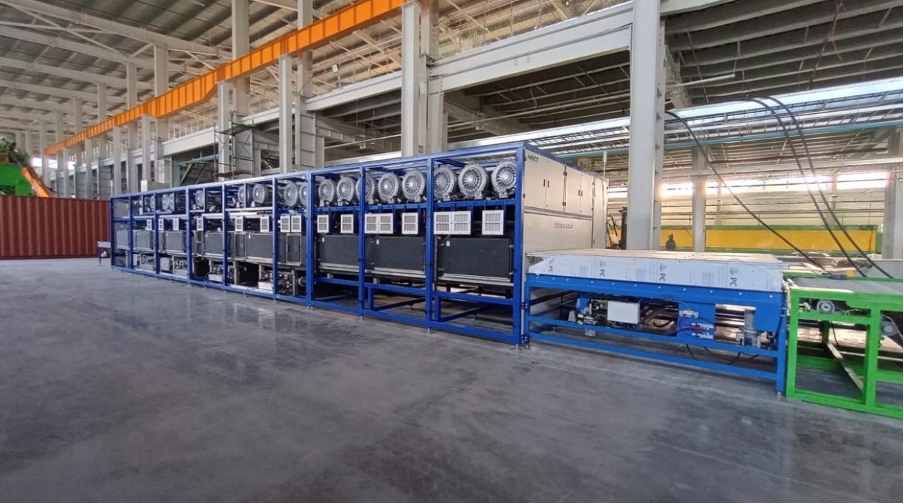
On more demanding lines, a 3-chamber pre-clean stage can be paired with an intermediate process, like vibro de-burring, before parts move into a separate 4-chamber final-wash line, giving manufacturers a way to combine surface finishing and precision cleaning without breaking the flow of production. Some configurations add gas heating and an integrated distillation unit with partial recovery and reuse distilled water back into the rinsing tanks of the system rather than wasting/treating it as a one-time consumable.
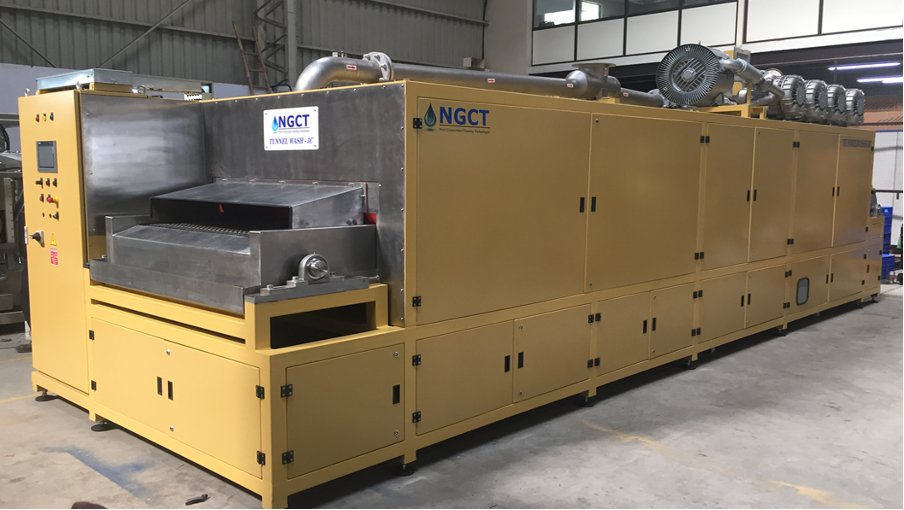
At the higher end, larger multi-chamber lines are built for demanding, high-value applications. NGCT has engineered 5-chamber TunnelWash systems specifically for cleaning EV battery cooling plates before fluxing and brazing, a part where cleanliness directly affects thermal performance and ultimately, battery life.
Built around how parts actually move through a plant
A cleaning line only works if it fits into the rest of the production flow, which is why tunnel washer configurations vary as much in material handling as they do in chamber count. NGCT has built lines with trolley/pallet/basket loading for automotive steering & engine parts, idler roller or motorised roller conveyors for empty basket/pallet return to loading station for high-volume components like two-wheeler crankshafts, each designed around how parts are staged, loaded, and moved on to the next process.
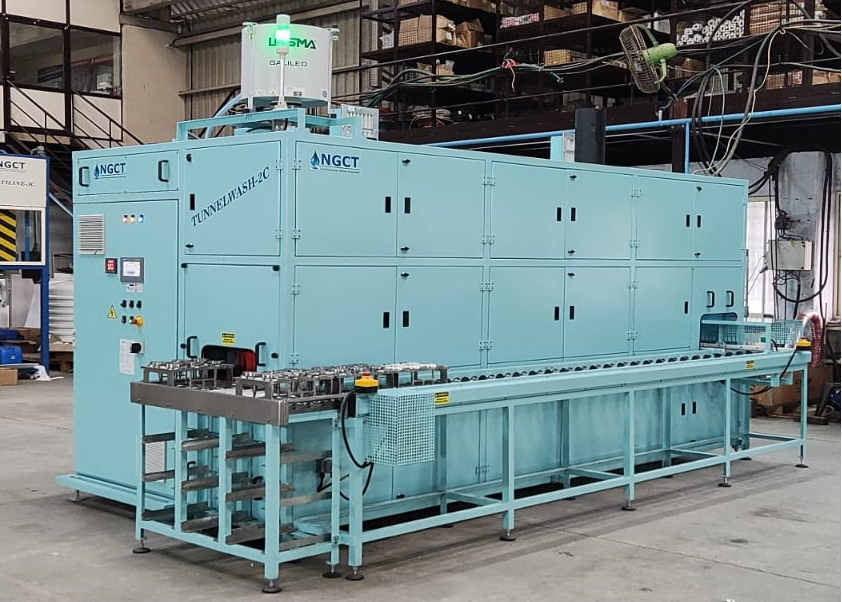
The output side matters just as much as the input. Parts should come off the line dry, uniformly clean, and ready for assembly or the next manufacturing step, not requiring a secondary cleaning pass to catch what the line missed.
Why manufacturers move to tunnel washers
For high-volume, flat-geometry parts, the case for a tunnel washer over batch cleaning comes down to a few consistent advantages:
- Throughput. A continuous line processes far more parts per hour than sequential batch tanks.
- Consistency. Every part follows an identical path through every zone, removing the variability that comes with manual batch handling.
- Reduced labour dependency. Automation cuts down on manual transfer between wash stages, reducing both labour cost and the risk of human error.
- Process flexibility. Chamber count, heating method, water recovery and rinse tank purification through distillation units, and material handling can all be configured to match the part and the production line, not the other way around.
The bottom line
Tunnel washers exist for a specific problem: cleaning a lot of parts, consistently, without the process becoming the constraint on production. As part volumes grow and applications like EV battery components raise the bar on what “clean” needs to mean, continuous, configurable cleaning lines are becoming less of an upgrade and more of a baseline requirement. NGCT’s TunnelWash systems are built to scale with that need, from compact 2-chamber lines to high-throughput Multi-chamber systems engineered around the part, not the other way around.